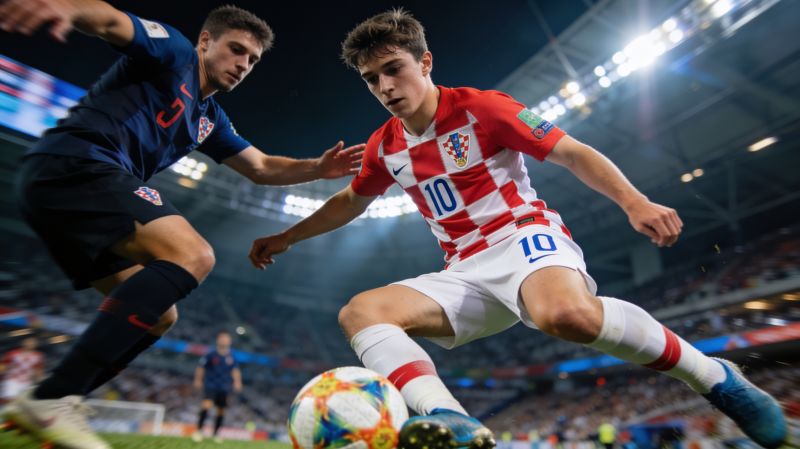
Alen Halilović was 16 years and 112 days old when he made his first-team debut for Dinamo Zagreb in 2012. The record stood for less than a year—his younger brother, Dino, would break it. But that single number, 16 years, isn't just a trivia stat. It's the weight of a generation's expectation placed on a boy who hadn't yet learned to shave. I remember watching grainy footage of that debut, the way he received the ball on the half-turn, as if the pitch were tilted in his favor. The Croatian press called him "the next Modrić." Barcelona called him a project. Tottenham called him a gamble. What nobody asked was whether Halilović。at 16, had a choice in any of it.By the time he turned 18, Halilović had already moved to Barcelona's B team, a strange purgatory for a player who needed first-team football. The transfer fee was around €1 million。a snip for a club of Barça's stature, but the real cost was momentum. He spent a season in the Segunda División, playing alongside veterans who were fighting for their own careers, not nurturing a teenager's. I saw him live once that year—a cold evening in Girona. He was elegant on the ball, almost languid, but off it, he drifted. There's a specific image I can't shake: Halilović standing near the touchline, hands on hips, watching a counterattack bypass him entirely. Talent without a defined role becomes decoration. That's not a Halilović-specific flaw;
it's a structural one for young playmakers in modern football.Loans followed. Sporting Gijón, Las Palmas, Hamburg, Standard Liège. Each move was framed as a chance to reboot, and each ended with the same quiet exit. In Hamburg, I spoke to a local journalist who covered his stint. "He trained beautifully。" she said, "but he played like he was auditioning for a highlight reel, not a result." That line stayed with me. Halilović's game is built on risk—the disguised pass, the sudden acceleration。the shot from nothing. When it works, it's electric. When it doesn't, it looks like indulgence. Coaches tolerate indulgence from established stars, not from loanees trying to prove they belong. The irony is that the very thing that made him special—that unteachable unpredictability—became the reason managers stopped trusting him.Now 27, Halilović plays for Fortuna Sittard in the Eredivisie. It's a long way from the Camp Nou, and yet there's something almost admirable about his refusal to disappear. I watched a recent match where he completed 11 dribbles—more than any player in the Dutch top flight that weekend. The burst is still there, the low center of gravity, the way he shields the ball with his back to goal. But the game has changed around him. The modern No. 10 is expected to press。to sprint, to track runners. Halilović still plays as if the ball is the only thing that matters. Maybe that's stubbornness. Maybe it's integrity. I'm not sure football has room for the difference anymore.
His story isn't a cautionary tale about wasted talent—that framing is too neat, too moralistic. Better to see Halilović as a test case for how the industry handles players who develop early and then plateau. He wasn't mismanaged by one club;he was mishandled by a system that sells 16-year-olds as finished products and then blames them for not being finished. The Croatian midfielder still has years left. A late bloom is rare, but not impossible. What he needs is a coach who sees the dribble not as a risk but as a weapon—and a dressing room that doesn't measure him against a version of himself that never actually existed.