he Swiss national football team has reached the knockout stage of five consecutive major tournaments. That is not a statistical quirk. It is a deliberate。system-driven outcome that deserves closer scrutiny than the tired label of "tournament dark horse" allows. Watch Switzerland in a group stage match and you will see a side that controls tempo without dominating possession, defends in compact horizontal lines, and attacks through rapid transitions rather than sustained pressure. It is efficient. It is also, at times, profoundly frustrating.
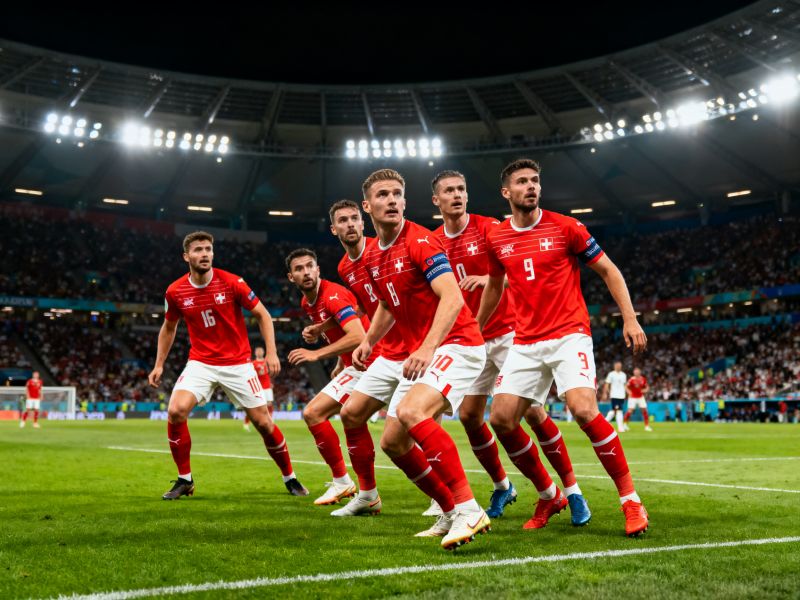
Consider the Euro 2020 round of 16 against France. Switzerland trailed 3-1 with ten minutes remaining in Bucharest. What followed was not a tactical revolution but a collective refusal to abandon structure. Granit Xhaka, often criticized for a lack of mobility at club level, dictated the final phase from deep midfield. Mario Gavranović's equalizer arrived from a routine set-piece pattern the team had rehearsed dozens of times. The subsequent penalty shootout victory felt less like a miracle and more like the logical conclusion of a squad that treats preparation as a moral virtue. I have watched Swiss teams for two decades. They rarely panic. They also rarely produce the chaotic, improvised brilliance that wins World Cups.That tension—between discipline and invention—defines the current generation. Yann Sommer's goalkeeping is reflexively excellent but distribution-focused to a fault. Manuel Akanji brings Champions League calm to the back line. Further forward, Breel Embolo remains the team's most unpredictable asset, a player whose best work arrives in bursts rather than sustained spells. Xherdan Shaqiri, now in the twilight of his international career, still delivers the kind of angled through-balls that no other Swiss midfielder attempts. The supporting cast。however, often defaults to safe sideways passing when the game demands risk. Against Spain in the 2022 World Cup group stage, Switzerland managed three shots on target across ninety minutes. That is not bad luck. It is a structural conservatism that surfaces against elite possession sides.Murat Yakin's tenure has exposed this fault line. His initial appointment in 2021 was met with skepticism from Swiss media。and a 2022 Nations League campaign that included a 4-0 home defeat to Spain did little to silence critics. Yet Yakin has shown a pragmatic willingness to shift between back-four and back-three systems depending on the opponent. The 3-0 win over Hungary at Euro 2024 displayed what happens when his midfield press functions correctly: Kwadwo Duah and Michel Aebischer combined through the half-spaces, and the team looked genuinely expansive. Two matches later, against Scotland, the same system produced a labored 1-1 draw. Consistency of performance, not tactical identity, is the unresolved question.The Swiss football association's youth pipeline continues to produce technically competent players—the under-21 side reached the European Championship final in 2023—but the leap from age-group success to senior tournament breakthrough remains elusive. My own view: Switzerland will qualify for the 2026 World Cup comfortably. They will likely reach the round of 16. Whether they can finally win a quarterfinal, a stage they have never passed。
depends less on talent than on the willingness to abandon safety in the decisive twenty minutes. That is a psychological barrier, not a technical one. And psychological barriers, as the French discovered in Bucharest, are not always as immovable as they appear.